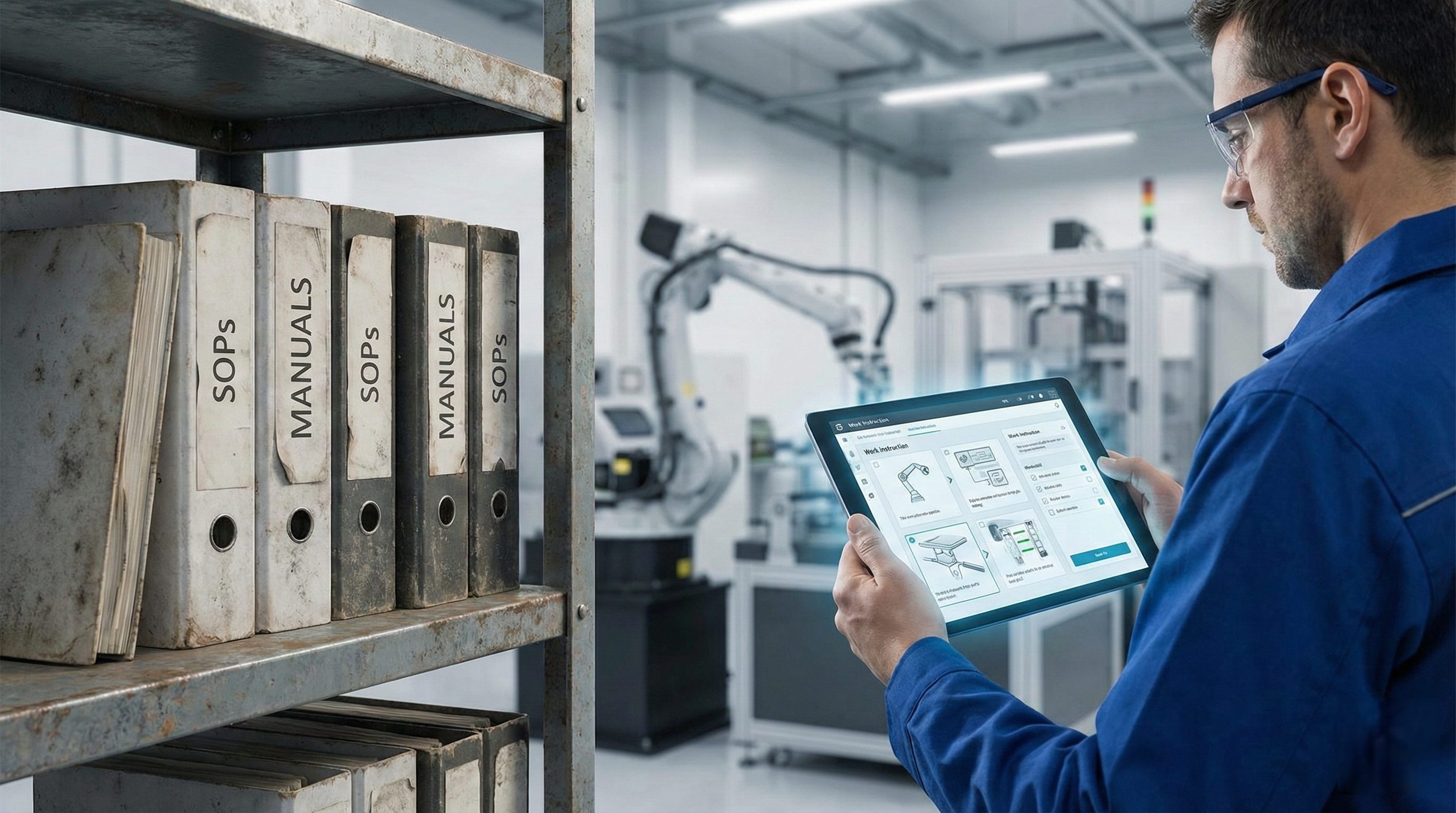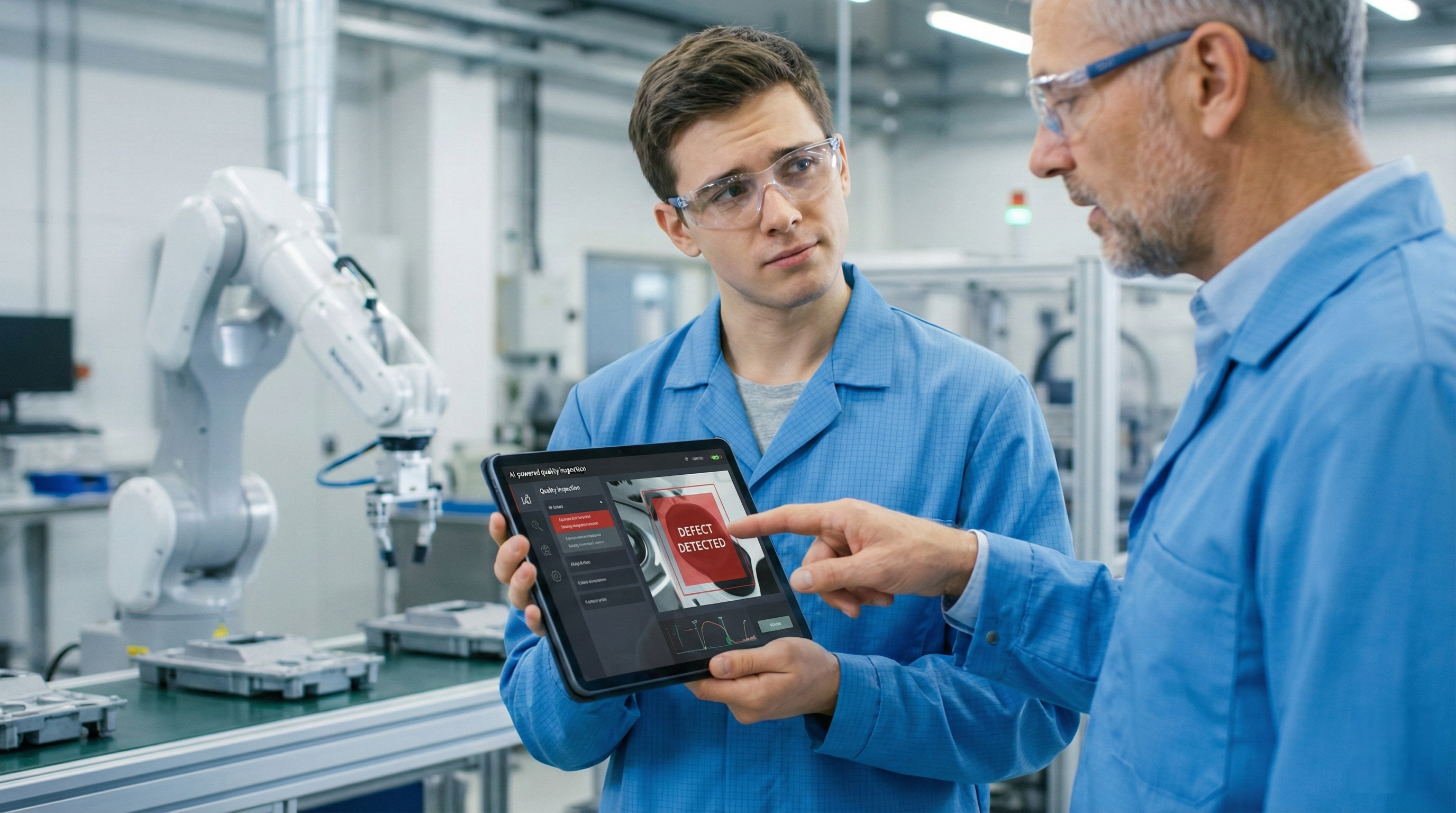
The plant spent fourteen months deploying AI-assisted visual inspection — camera arrays, a model trained on 40,000 images, real-time flagging on tablets at each station. On time, under budget, 97.3% accuracy in testing.
Six weeks after go-live, defect escape rates hadn't budged.
Operators would see the AI flag something that looked fine to them and override it. Not maliciously — they just didn't trust a camera over fifteen years of hands and eyes. When the AI disagreed with their gut, their gut won.
On paper: technology readiness problem. In reality: human readiness problem. The AI worked. The people weren't ready to work with it.
98% Exploring, 20% Ready — But Ready for What?
A January 2026 Redwood Software/Leger Opinion survey found 98% of manufacturers exploring AI. Only 20% consider themselves fully prepared.
That 78-point gap deserves attention. But look at what "prepared" means: infrastructure, data pipelines, system integration, IT budgets. The question is do you have the tech stack?
Fair question. Incomplete question.
A TCS study found 75% of manufacturers expect AI to be a top-three margin driver by 2026, but only 21% report full readiness. Same gap. Same framing. Systems and infrastructure.
Nobody is measuring whether the people on the floor — the ones interacting with AI tools every shift — are competent to do so. Not "aware of." Not "trained on." Competent. Can they use the AI-augmented process correctly, consistently, and safely?
For most manufacturers, the honest answer is: we have no idea.
$120M for Tools, $0 for Validation
In January 2026, Tulip raised $120M to reach unicorn status — a clear signal that capital markets believe manufacturing automation is about to accelerate hard.
They're probably right. The tools are genuinely good: AI-powered quality inspection, predictive maintenance, automated scheduling, digital work instructions. The platform layer is maturing fast.
But watch the implicit assumption: if the software is good enough, adoption follows. Build a better tool, the workforce figures it out.
Training budgets exist. LMS platforms get purchased. E-learning modules get assigned. Completion rates get tracked. But completion ≠ competence. An operator who clicked through a 45-minute module and scored 80% on a quiz has "completed training." Whether they can interpret the AI's output on a live line — under time pressure, with parts that don't match the training images — is a completely different question.
One almost nobody is answering.
Why "Train Workers on AI" Misses the Point
Kriti Sharma's January 2026 Fortune op-ed — "Let's train workers on industrial AI, not replace them" — had the right instinct. But the framing stops one step short.
Training is necessary. Obviously. The problem is assuming training, by itself, closes the gap.
It doesn't. The gap between "I took the course" and "I can perform the task" is one of the most studied phenomena in workforce development. Knowledge transfer from classroom to real-world performance is unreliable — learning science has known this for decades.
In manufacturing, this isn't academic. When an aerospace operator can't correctly interpret an AI flag on a critical fastener installation, that's a nonconformance waiting to happen. When a medical device assembler overrides an AI quality check because they don't understand confidence thresholds, that's a potential field failure.
"Train them" is the starting line, not the finish line. The industry is treating it as both.
The Human Readiness Gap
Readiness at the operator level — where AI tools actually succeed or fail — looks like this:
Understanding the tool's role. Not just "this camera checks for defects" but knowing the AI's limitations, when to trust it, when to escalate.
Performing the augmented workflow. AI-augmented work has different decision points, escalation paths, and interactions. The operator executes the new process, not the old one with a gadget they ignore.
Responding when the AI and their experience disagree. This is where deployments break down. The AI flags something, the veteran thinks it's fine. Without clear competency around this scenario, the operator overrides, the AI becomes wallpaper, and you've spent $2M on a very expensive screensaver.
None of this is captured by training completion records or LMS dashboards.
The human readiness gap is the real readiness gap — and it's invisible to every measurement system most manufacturers have.
Closing the Gap That Actually Matters
Stop measuring training hours. Start measuring demonstrated capability. A training record says someone sat through content. The metric that matters: can this operator execute this procedure, with this AI tool, correctly and safely? If you can't answer with evidence, you don't know your readiness state.
Define competency for the augmented workflow. Most competency frameworks are written for pre-AI work. Working with an AI quality inspector is a different skill than manual visual inspection. Standards need to reflect how the work is actually performed now.
Make the human readiness gap visible. Most manufacturers can tell you exactly which machines have AI deployed and which operators completed training modules. Almost none can tell you which operators have demonstrated competence on the AI-augmented process. Technology readiness is tracked obsessively. Human readiness is assumed.
Validate, don't just train. Training is input. Validation is output. Train operators on the new workflow, then verify — through observed performance, not quizzes — that they can execute it. Flight simulators have worked this way for decades. Manufacturing is just behind.
The Uncomfortable Question
The manufacturing AI market is moving fast. The 98% exploration rate means nearly everyone is thinking about this. But the gap between thinking about AI and being ready for it isn't primarily a technology gap. It's a human gap — the space between deploying a tool and knowing, with evidence, that your workforce can use it.
Every dollar spent on AI tooling without validating human competency is a bet. Maybe people figure it out on their own.
Or you end up with a 97.3% accurate system that nobody trusts, override rates that make the AI irrelevant, and a readiness assessment that says all green because the infrastructure is solid and the training records are complete.
The technology readiness gap is real, and it's getting solved — with money, platforms, and $120M funding rounds.
The human readiness gap is just as real. And almost nobody is working on it.
Your training records say your team completed the AI module. But can they actually work with it? That's the question skills validation answers — and it's the one most manufacturers aren't asking yet. See how it works →