Three months ago, a quality manager at an aerospace tier-2 supplier walked me through their NCR from hell. Defense contract. ITAR-controlled. 127 operations per assembly, every one requiring sign-off. They'd spent 18 months building out their Dozuki instance—procedures for everything, revision control, the works.
A batch failed acceptance testing anyway. Fastener torque on step 47.
The operator had signed off. The supervisor had signed off. Dozuki showed the procedure was accessed, acknowledged, completed. The checkbox was checked.
The torque was still wrong.
"We had perfect documentation," he said. "What we didn't have was any way to know if the guy actually did it right."
He was calling me because he thought switching platforms would fix something. It won't.
Why You're Actually Here
You searched "Dozuki alternatives." Let's skip the pretense about what that means.
It's the price. Dozuki runs $50K-$200K/year depending on scale. That's a lot of money to spend on fancy PDFs. Especially when you can't point to hard ROI.
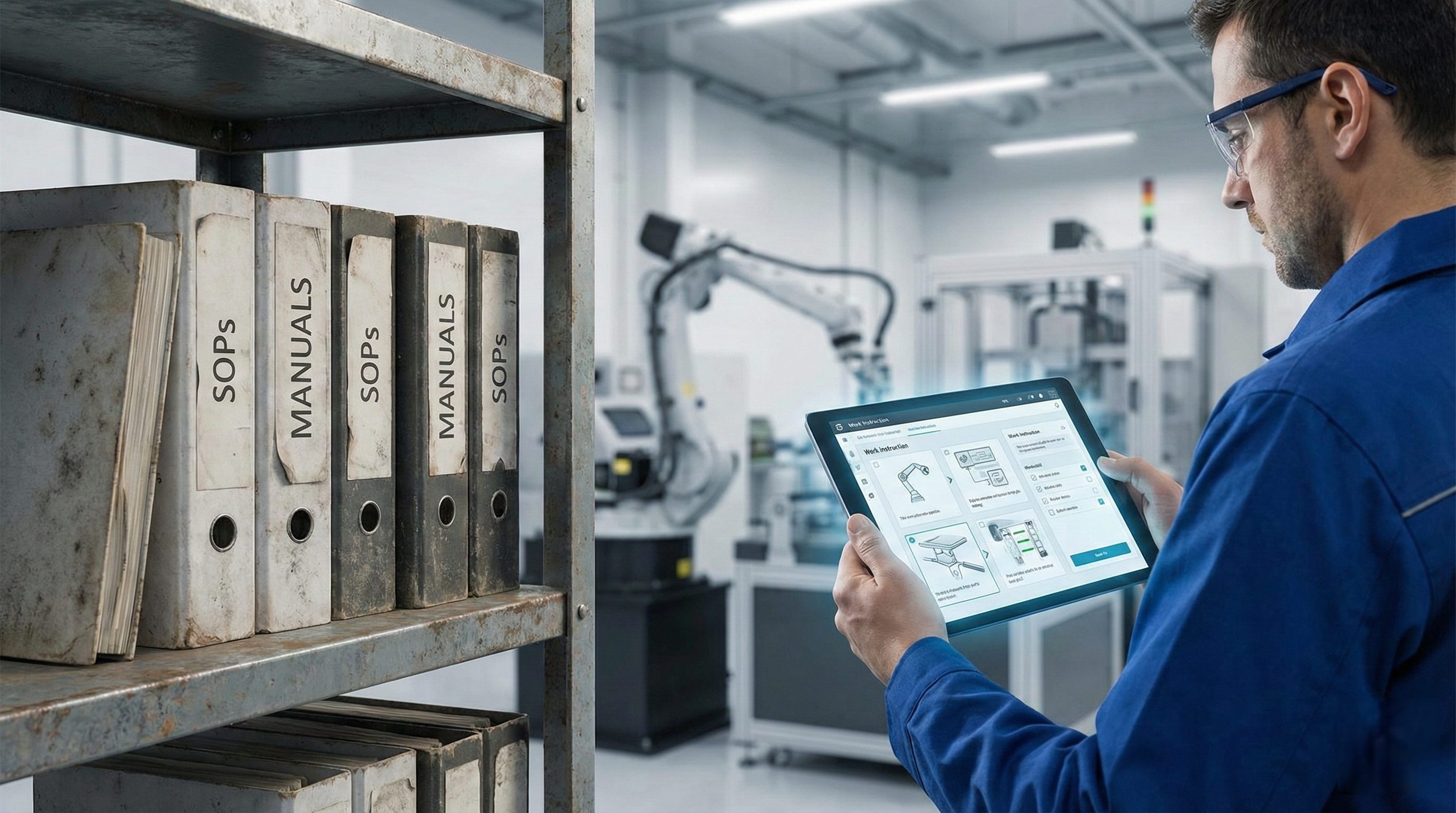
It's the friction. Getting floor workers to actually use it is a constant battle. The interface isn't exactly intuitive. Half your procedures end up outdated because updating them is a chore.
It's the sneaking suspicion that you're paying enterprise prices for a glorified wiki.
Fair enough. There are other options.
The Comparison Everyone Else Will Give You
If you just want a different work instructions tool, here's the shortlist:
Azumuta — Belgian company, strong in EU manufacturing. Cleaner UX than Dozuki. More transparent pricing. Good if you're tired of "contact sales" games.
SwipeGuide — Stripped down, mobile-first. Great for one-point lessons. If Dozuki feels like overkill, this is the opposite end of the spectrum.
VKS — Been around forever. Solid for discrete manufacturing with station-based work. Data capture is decent.
Tulip — The "platform play." Work instructions are one piece of a larger connected worker pitch. Modern interface. Can get expensive and complicated fast.
PICO — Integrated frontline suite. Work instructions plus checklists plus messaging. Good if you want one vendor for everything.
All competent products. All do basically the same thing: create digital procedures, distribute them to workers, record that workers accessed them.
Pick whichever one annoys your team least. Move on with your life.
But.
The Uncomfortable Part
Every tool I just listed—Dozuki included—solves the same problem: making documentation easier to create and distribute.
What none of them solve is the problem that actually matters.
When your quality manager signs off on a batch, they're attesting that procedures were followed. When your auditor reviews training records, they're checking that workers accessed the documentation. When you pass an ISO 9001 surveillance audit, you're demonstrating that documented procedures exist and that there's evidence of training.
None of this proves anyone can actually do the work correctly.
A checkbox proves someone clicked a checkbox. A signature proves someone signed their name. An access log proves a document was open on someone's screen.
That's it. That's all you've got.
The Polite Fiction
I call it the polite fiction of documented competency.
You write the procedure. Worker accesses it. Boxes get checked. Supervisor signs. System records "complete." Everybody moves on.
Nobody actually verified that the procedure was executed correctly. You verified paperwork. The execution itself? Faith-based quality assurance.
For routine work, this is fine. Catch errors at inspection, fix them, move on.
For work where errors are catastrophic? You're building on sand.
Where Faith-Based QA Fails
Aerospace and defense. AS9100 requires documented training. FAA wants evidence of competency. Your QMS has sign-offs at every step. And yet—NCRs still trace back to operator error on documented procedures. The paperwork was perfect. The execution wasn't.
Medical devices. 21 CFR 820.25 requires personnel to be trained and competent. Most companies demonstrate this with training records and procedure acknowledgments. FDA keeps issuing 483s citing "inadequate training" anyway. Because the records showed training. They didn't show competence.
Any regulated manufacturing. ISO 9001 Clause 7.2 requires "documented information as evidence of competence." Auditors accept training records. Then quality escapes happen. Root cause analysis points to execution gaps on procedures that were fully documented and fully signed off.
Same pattern every time. Documentation was fine. Execution wasn't. The system designed to ensure quality had no mechanism to verify quality.
What You're Really Asking
So when you search "Dozuki alternatives," what are you actually trying to solve?
If the answer is "Dozuki costs too much" or "my team won't use it" or "the interface is clunky"—fine. Switch platforms. Any of the tools I listed will work. Pick based on price, UX, whatever matters to you. This isn't complicated.
But if the answer is "we have documented procedures and we're still seeing execution errors"—that's different.
That's not a Dozuki problem. That's not a documentation problem at all.
No documentation tool is designed to verify that work was performed correctly. They're designed to present information and record that information was presented. That's the category. That's what these products do.
If you switch from Dozuki to Azumuta or VKS or anything else in this category, you'll spend six months migrating procedures, retraining everyone, convincing the floor to adopt yet another system—and you'll still have the same gap. Documented procedures. Unknown execution.
The Category You Actually Need
The thing that closes this gap is called skills validation. Different category. Different approach.
Documentation workflow: Create procedure → distribute → worker views → checkbox → "completed"
Validation workflow: Worker performs task → system observes execution → verifies each step was done correctly → "validated"
The difference is evidence. Documentation produces evidence of viewing. Validation produces evidence of doing.
When an auditor asks "how do you know this worker can perform this procedure correctly?"—documentation gives you access logs and signatures. Inference.
Validation gives you a recording of observed performance showing they actually executed the procedure correctly. Proof.
One is paperwork. The other is reality.
The Actual Answer
So. Best Dozuki alternative?
Depends what problem you're solving.
If your problem is the tool itself—cost, complexity, adoption friction—then yeah, switch tools. I gave you the list. They're all fine. Evaluate on your specific needs and pick one.
If your problem is the gap between documented and executed—if you're tired of sign-offs that don't mean anything, training records that don't predict performance, audits that miss execution failures—then switching documentation tools is a waste of time. You need something that actually verifies the work got done right.
Documentation shows you what should happen. Validation shows you what did happen.
Most companies have plenty of the first. Almost none have the second.
Next Steps
If you're still shopping for documentation tools: pick the one your team will actually use. Adoption beats features every time. The best work instructions software is whatever your floor doesn't fight.
If the gap I described sounds familiar—if you're starting to wonder whether better documentation is even the right question—then look into what skills validation actually looks like. Not as a replacement for work instructions. As the layer that verifies execution after documentation has done its job.
Either way, at least now you know what question you're asking.
If you want to see what validation looks like in practice, we should talk. Or read the longer version: Your Training Records Are Lying to You.