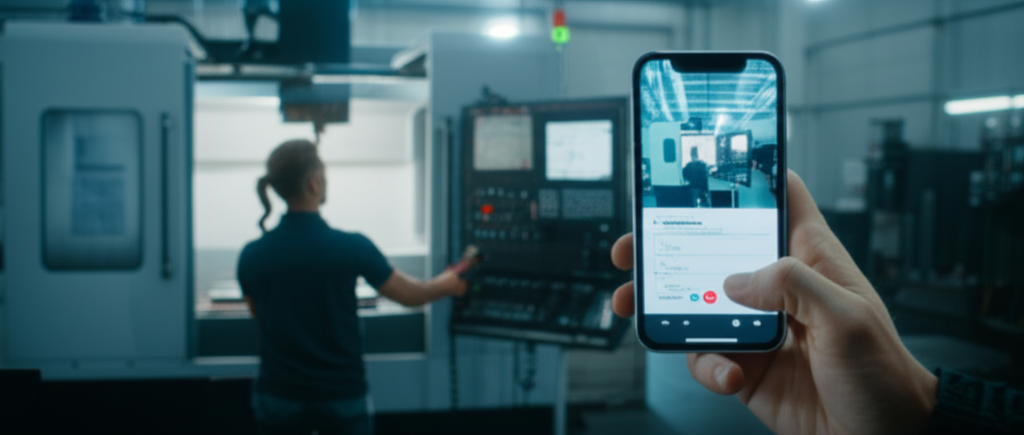
You verify worker competency in manufacturing by observing them perform the actual task — not by checking that they sat through a training session. The gold standard has always been witnessed performance, and now AI-powered tools like skillia.AI can do that observation at scale, generating audit-ready proof every time.
Here's a scene that plays out every week in manufacturing: An auditor asks to see competency records for a brazing operation. The quality manager pulls up a training log. It shows the operator completed a 45-minute e-learning module in March. The auditor asks, "But how do you know they can actually do it?" Silence.
That silence is the gap between training completion and competency verification. And it's where most manufacturers get stuck.
The Signature Problem
For decades, competency "verification" in manufacturing has looked like this: a supervisor signs a form that says "I observed John perform this task." Maybe they did. Maybe they were across the shop floor and John seemed fine. Maybe they signed six forms at once on a Friday afternoon.
The signature method has three fatal flaws:
- It's subjective. Two supervisors might have completely different standards for "competent."
- It's inconsistent. The same supervisor might be thorough on Monday and rushed on Friday.
- It's unverifiable after the fact. When the auditor shows up, all you have is a signature. No video. No criteria checklist. No evidence of what was actually observed.
This matters because the standards don't just ask for training records — they ask for competency evidence.
What the Standards Actually Require
AS9100 (aerospace) requires organizations to determine the "necessary competence" of persons doing work and "take actions to acquire the necessary competence, and evaluate the effectiveness of the actions taken." That last part — evaluate the effectiveness — is where most companies fall short.
FDA 21 CFR Part 211 requires personnel to have "the education, training, and experience" to perform their functions. During inspections, FDA investigators increasingly ask how you know someone is competent, not just that they were trained.
IATF 16949 (automotive) goes further, requiring organizations to identify training needs and verify that operators are "aware of the relevance and importance of their activities." Awareness isn't demonstrated by a quiz score.
The common thread: regulators and auditors want proof of capability, not proof of attendance.
Moving Beyond Check-the-Box
Some manufacturers have tried to bridge the gap with practical assessments — hands-on tests administered by trainers or supervisors. This works, but it doesn't scale. You can't have a trainer standing next to every operator for every critical task across every shift.
Others use skills matrices — spreadsheets that map which operators are qualified for which tasks. The matrix tells you who should be able to do the work. It doesn't tell you who actually can, or whether their skills have degraded since they were last assessed six months ago.
The real solution is building verification into the work itself. When an operator performs a critical procedure, that performance should be captured and evaluated against defined criteria — every time, not just during annual recertification.
How AI Changes the Equation
This is exactly what skillia.AI was built to do. Workers record themselves performing a procedure using a phone or tablet. The AI watches the recording and validates whether the steps were performed correctly, in the right order, with the right technique. The result is a timestamped, audit-ready competency record — not a signature, not a quiz score, but actual evidence of observed performance.
No scheduling a trainer. No hoping the supervisor was paying attention. No retroactive paperwork.
It's what competency verification was always supposed to be — just without the bottleneck of requiring a human observer for every single task.
FAQ
How often should you verify worker competency?
At minimum, during onboarding and annual recertification. But best practice is continuous verification — assessing competency as part of regular work, not just during formal evaluations.
What's the difference between competency and qualification?
Qualification means meeting documented requirements (certifications, training hours). Competency means demonstrating the ability to actually perform the task. You can be qualified on paper and incompetent in practice.
Can you use video to verify competency?
Yes — and increasingly, companies are. Video-based verification provides objective, reviewable evidence that a task was performed correctly. AI tools like skillia.AI can evaluate these recordings automatically against defined criteria.