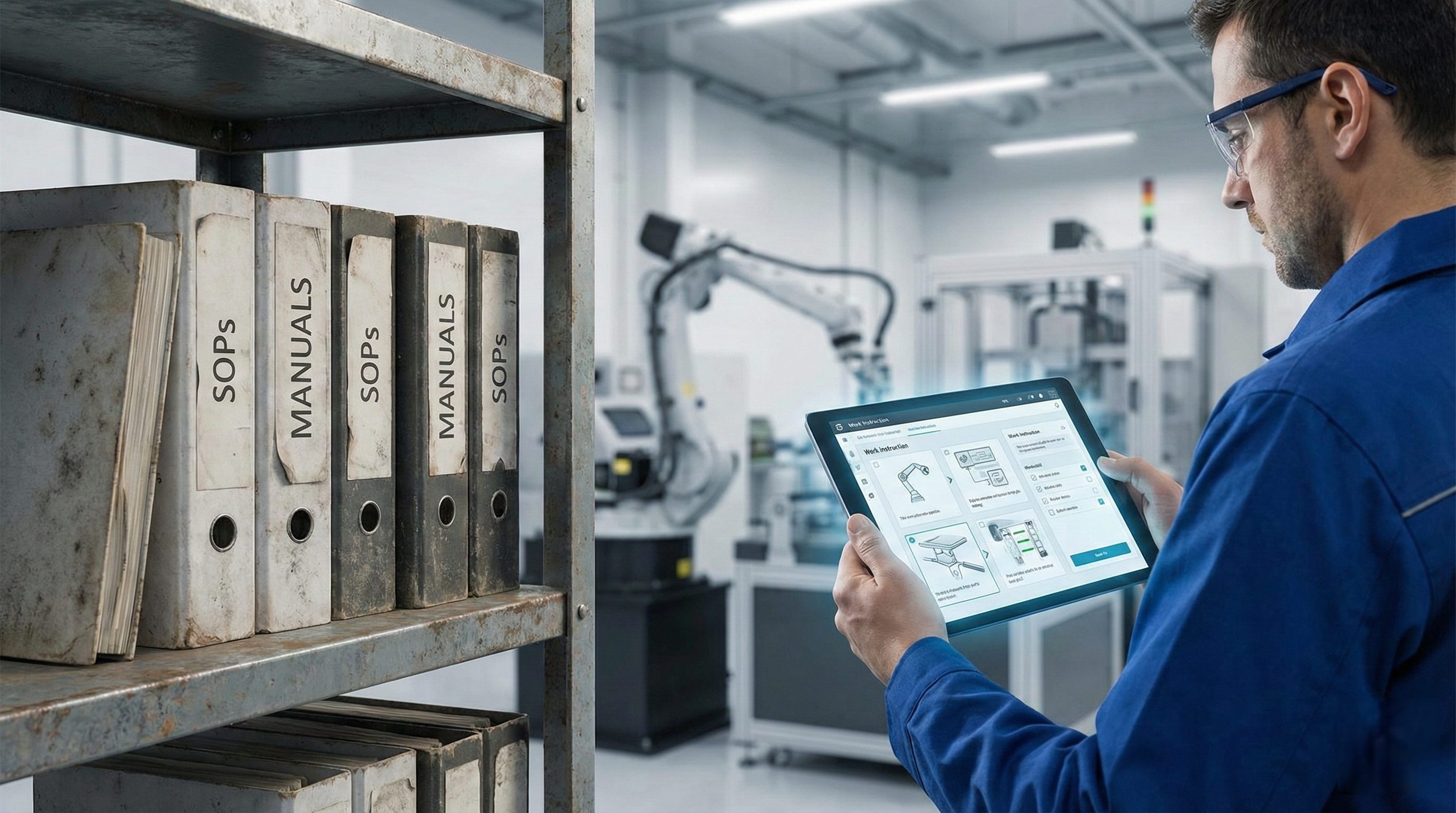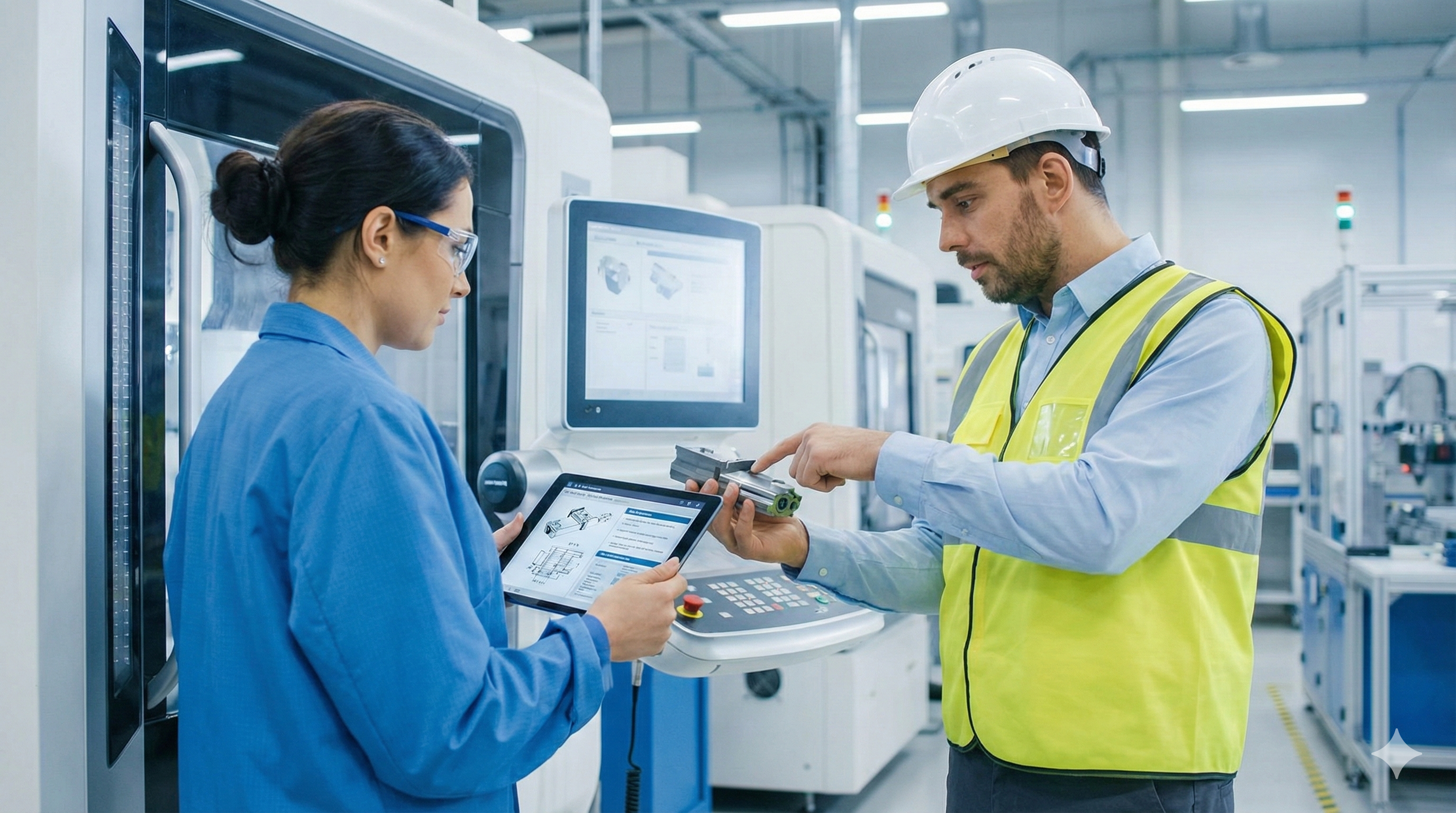
Dozuki just announced their "most successful year to date." Forty-five percent growth in enterprise customers. New data centers in Frankfurt, Paris, Singapore, Tokyo. Strategic partnerships across Germany, France, Spain, Southeast Asia, Poland. A 724% increase in documents digitized with their AI tool.
Congratulations. Genuinely.
They've spent fourteen years proving that digital work instructions are a real category. That manufacturers will pay real money to replace paper binders with structured digital procedures. That the connected worker platform isn't a fad.
That's validated now. Dozuki just gave you the proof.
So let's talk about what happens next.
The Documentation Problem Is Solved
Read Dozuki's announcement carefully. Here's what they're celebrating:
- A quarter million new guides created
- 2.7 million work orders tracked
- 64% increase in learning pathway usage
- AI that converts tribal knowledge into documentation 7x faster
- 120-day average deployment time
This is impressive. It also describes a very specific achievement: getting procedures out of people's heads and onto screens. Faster, at scale, globally.
That problem? It's handled. If you're a manufacturer in 2026 and you still can't get your work instructions digitized, you have options. Dozuki. Azumuta. VKS. SwipeGuide. Tulip. Pick one. They all do this well enough.
The documentation layer is table stakes now.
The Question Nobody's Answering
Dozuki's announcement mentions "operational excellence" fourteen times. "Workforce development." "Skills gap." "Getting workers floor-ready."
Here's what it doesn't mention: how do you know the worker actually learned anything?
Their system tracks that procedures were created, distributed, accessed, and acknowledged. Their learning pathways track that training was assigned and completed. Their work orders track that steps were signed off.
All of this is evidence of process. None of it is evidence of competence.
When an operator completes a Dozuki learning pathway and then signs off on a work order, what do you actually know? You know they had access to the documentation. You know they clicked through the training. You know they checked the boxes.
You don't know if they can do the work correctly. You inferred it. You didn't verify it.
This isn't a Dozuki problem. It's a category problem. Every connected worker platform on the market—every single one—treats "accessed the documentation" as a proxy for "can perform the task." Because that's what the category was built to do. Present information. Record that information was presented.
That was the right problem to solve first. You can't validate skills against procedures that don't exist. Documentation had to come first.
It came first. It's here. Dozuki just proved it with a 45% growth number.
Now what?
The 724% Number That Should Worry You
Dozuki's proudest stat is that AI-powered documentation creation increased 724% year over year. Which means their customers are creating procedures seven times faster than before.
Think about that for a second.
If the bottleneck was always "we can't create documentation fast enough"—and AI just obliterated that bottleneck—then documentation is about to become commodity infrastructure. Every manufacturer will have comprehensive digital procedures within a year or two. The competitive advantage of having documentation disappears when everyone has it.
So what differentiates you?
Not the procedures. Everyone has those. Not the sign-offs. Everyone has those too. Not the training records. Same story.
The differentiator is whether your people can actually execute. Whether your training produces real competence, not just completed checklists. Whether you can prove—to auditors, to customers, to yourself—that the person performing step 47 actually torqued that fastener correctly.
Documentation tells you what should happen. The question Dozuki's growth makes urgent is: can you prove what did happen?
The Gap Gets Wider
Here's the uncomfortable math.
Dozuki's AI creates documentation 7x faster. That means 7x more procedures existing in your system. Which means 7x more sign-offs needed. Which means 7x more opportunities for the gap between "documented" and "executed" to create quality escapes.
More documentation doesn't mean better execution. It can actually mean worse visibility, because the volume of "completed" training records creates a false sense of coverage.
Your QMS shows 100% procedure compliance. Your training matrix is green across the board. Every learning pathway completed. Every work order signed off.
And then a batch fails acceptance testing because someone didn't actually know how to do step 47. They had the documentation. They completed the training. They signed off. They just couldn't do it right.
This is the pattern that scales with documentation volume. More procedures, more check-marks, same execution uncertainty.
What Comes After Documentation
The manufacturing technology stack has a missing layer.
You've got ERP for planning. MES for execution tracking. QMS for quality management. And now, thanks to Dozuki and the connected worker category, you've got comprehensive digital work instructions.
What you don't have is validation. Actual evidence that a human being can perform a specific task correctly.
Not "they viewed the procedure." Not "they passed a quiz." Not "they signed off." Evidence. Observable, auditable proof of competent execution.
This is what skills validation does. The worker performs the task. The system observes the execution—step by step, against the documented procedure. It verifies each step was completed correctly. The output isn't a checkbox. It's a validated assessment with evidence.
When the auditor asks "how do you know this person can do this?"—you don't hand them a training record and hope for the best. You hand them a recording of validated performance.
Documentation is the input. Validation is the output. You need both.
The Real Congratulations
So yes—congratulations to Dozuki. They built a real company solving a real problem, and their 2025 numbers prove the market agrees.
But their success is also a signal. The documentation problem has been solved well enough, at scale, that it's time to ask the next question.
You've got the procedures. You've got the training paths. You've got the sign-offs. The infrastructure is there.
Can your people actually do the work?
If you're honest, you don't know. Nobody in your building knows. Your documentation system wasn't designed to tell you, because that's not what documentation systems do.
The companies that figure out this next layer—that close the gap between documented and validated—will have something their competitors don't: proof. Not compliance theater. Not checkbox assurance. Actual evidence that their workforce can execute.
Dozuki built the foundation. Somebody has to build what goes on top.
We're building that layer. If you want to see what skills validation looks like when it sits on top of your existing work instructions, try it free — 5 SOPs, no credit card.
Skillia Team is the founder of skillia.AI, an AI-powered skills validation platform for manufacturing.