I liked SwipeGuide. I want to say that upfront, before this turns into a pitch.
Most work instructions platforms try to be everything — connected worker suite, IoT integration, AI-powered analytics, digital twin interface, whatever the last Gartner report said to build. SwipeGuide looked at all of that and said: no. Make it simple. Make it mobile. Make it something a floor worker will actually open.
That restraint is rare, and it worked. Heineken rolled it out. Coca-Cola HBC. Process manufacturers across Europe who were tired of buying enterprise software that nobody on the floor touched. SwipeGuide's adoption rates were genuinely impressive, because turns out, if you make something easy to use, people use it.
Then L2L acquired them. And now you're here, searching for SwipeGuide alternatives.
Why the L2L Acquisition Has People Nervous
Let's name what's happening. L2L — Leading2Lean — is a manufacturing execution platform. They bought SwipeGuide to bolt work instructions onto their MES stack. Makes strategic sense from L2L's perspective.
From yours? Less clear.
SwipeGuide's whole identity was being the lean, independent, mobile-first option. The anti-enterprise play. Now it's a feature inside an enterprise platform. The product roadmap is no longer driven by "what do frontline workers need?" It's driven by "how does this fit into L2L's suite?"
If you're a SwipeGuide customer who chose it specifically because it wasn't a bloated enterprise tool — that's an uncomfortable position. Your simple tool just got complicated. Not in UX, maybe. In strategy.
Maybe L2L keeps it lean. Maybe the product stays great. But "maybe" isn't what you want from software your floor depends on.
The SwipeGuide Competitors Worth Knowing
If you're evaluating SwipeGuide alternatives, here's what's actually out there:
Dozuki — Step-by-step authoring with strong revision control. The go-to for regulated environments. More structured than SwipeGuide, but heavier. If you liked SwipeGuide's simplicity, Dozuki might feel like going back to enterprise.
Poka — Factory-focused, social knowledge sharing. Workers post tips, flag issues, share solutions. Good adoption because it feels less top-down. Closer to SwipeGuide's spirit than most.
Augmentir — AI-powered connected worker platform that personalizes instructions based on worker proficiency. Interesting concept, complex implementation, steep price tag.
VKS — Visual Knowledge Share. Mature product for discrete manufacturing. Station-based work instructions with data capture. Solid, not exciting.
Tulip — The platform play. Work instructions are one module in a broader no-code manufacturing app builder. Powerful if you want to build custom workflows. Overkill if you just want mobile work instructions.
All reasonable options. If your main concern is "SwipeGuide might change under L2L and I need a stable alternative" — any of these will do the job. Pick based on what SwipeGuide did well for you and find the closest match.
Poka if it was adoption. VKS if it was structure. Dozuki if you need regulatory rigor.
But I have to be honest about something.
The Thing SwipeGuide Got Right (and Wrong)
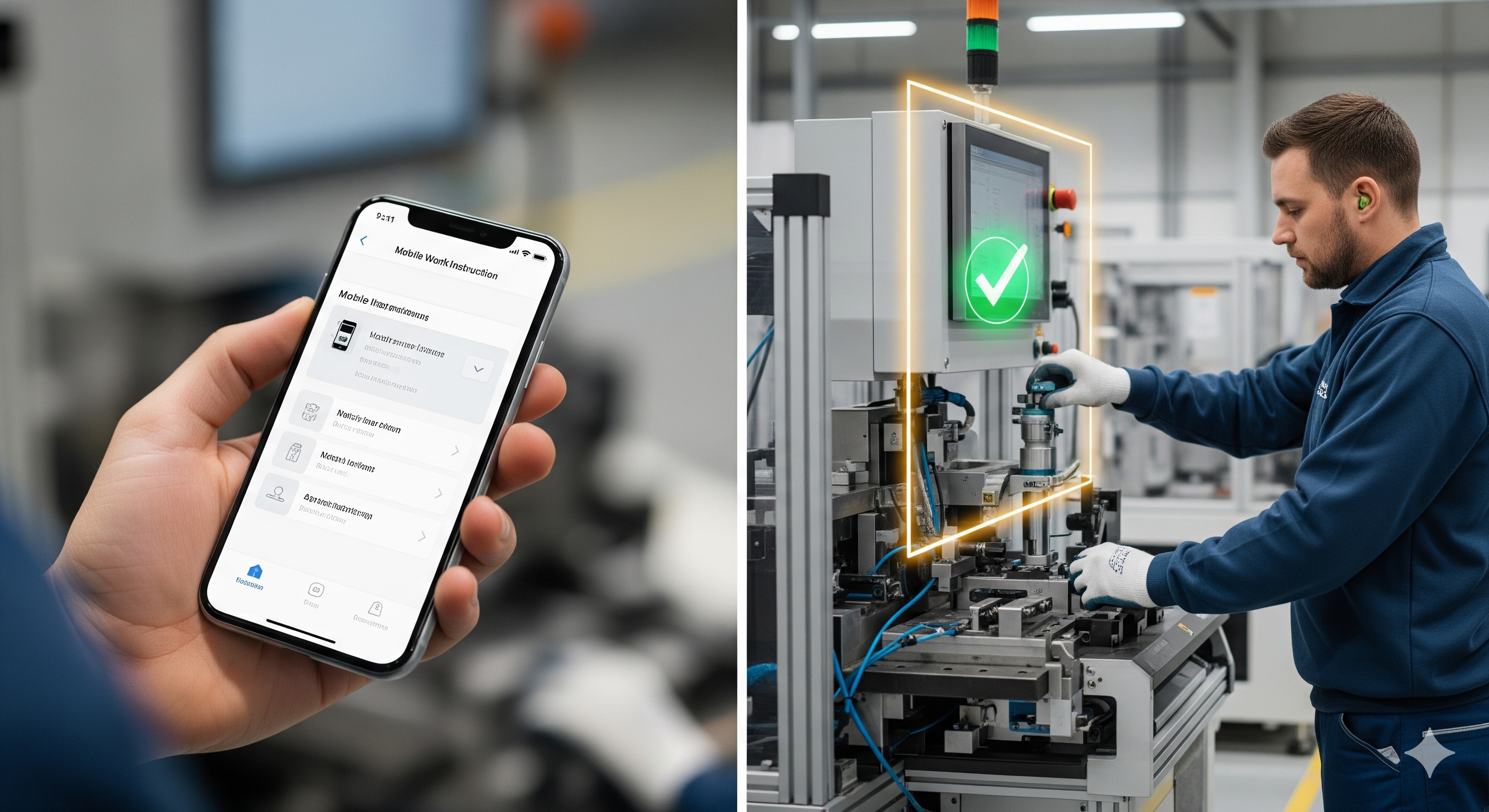
SwipeGuide understood something most work instructions vendors don't: adoption is the only metric that matters. The best procedure ever written is worthless if nobody reads it. So they optimized for the worker, not the manager. Clean screens, three taps to find your instruction, works on a phone in a hairnet.
Admirable. Correct, even.
Here's the problem: SwipeGuide optimized for the viewing experience. And viewing isn't doing.
A one-point lesson on a phone screen is great for reminding an experienced operator of a sequence. It's genuinely useful as a quick reference. But when a new hire swipes through that same lesson, taps "done," and walks up to the machine — do you know if they can actually perform the task?
SwipeGuide doesn't. It knows they swiped. It recorded the completion. The simplicity that made it great for adoption is the same simplicity that makes it invisible as a verification tool. No video capture. No AI-assisted assessment. No skill verification. It was never designed for that.
And honestly, neither were the SwipeGuide competitors I just listed. This isn't a SwipeGuide problem.
Ease of Use ≠ Proof of Competency
This is the part that applies regardless of which platform you choose.
Mobile work instructions — all of them — solve distribution. They get the right procedure in front of the right worker at the right time. SwipeGuide did this better than most because they made it frictionless.
But distribution is not verification. Making something easy to access doesn't mean the person who accessed it can execute it correctly.
Your training matrix says the operator completed the OPL. Your LMS says the module is done. SwipeGuide says the guide was viewed. Everyone agrees: this person is "trained."
Then they cross-thread a fitting, or skip a sanitation step, or torque a fastener wrong. And when you investigate, the records look perfect. Every box checked. Every guide viewed. Every completion logged.
The paperwork was flawless. The work wasn't.
What Validation Actually Looks Like
The missing piece isn't a better work instructions app. It's a different layer entirely.
Work instructions say: "Here's how to do it."
Completion tracking says: "They saw how to do it."
Validation says: "They showed they can do it."
That third line is what's absent from every tool in the SwipeGuide alternatives conversation. Not because they're bad products. Because verification is a different category.
You don't ditch your work instructions platform to get validation. You add validation alongside it. The guide tells the worker what to do. Validation confirms they actually can.
SwipeGuide was right that simplicity drives adoption. But simple guides that get adopted and simple guides that prove competency are two different achievements. The industry has the first one figured out. The second one barely exists.
So What Now?
If the L2L acquisition is your concern — if you just need a stable, mobile-first work instructions tool — pick from the list above. Poka and VKS are safe bets. Evaluate based on your floor's needs, not feature sheets.
But if you're switching because you've realized that high adoption and beautiful completion dashboards still didn't prevent the last quality escape — then switching platforms won't fix that. You'll migrate everything, retrain your floor, and have the same gap in a different interface.
The question worth asking isn't "which mobile work instructions tool?" It's "do I actually know if my people can do the work?"
If you've never had a good answer to that second question, it might be time to look at what skills validation looks like in practice.
Build 5 SOPs with built-in skills validation — free, no credit card. See what "trained" looks like when it actually means something: skillia.ai/try