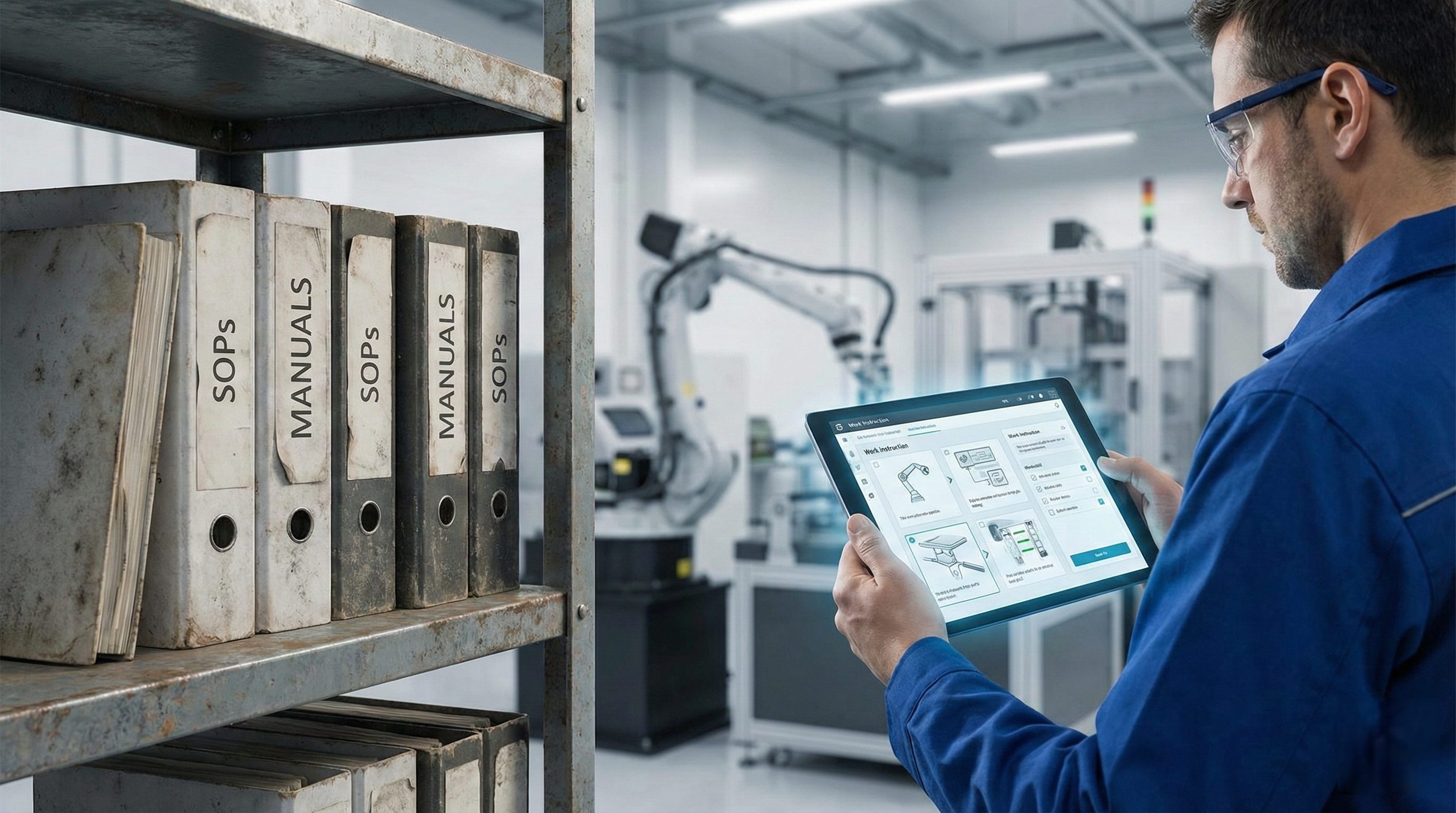
A quality engineer at an automotive tier-1 supplier showed me something last quarter that stuck with me. They'd been running VKS for three years. Every station on the line had step-by-step visual instructions with annotations, photos, the whole setup. Operators entered measurements at each step. Torque values, gap checks, visual confirmations. The data collection was immaculate.
They still shipped 1,200 defective brackets to their OEM customer.
The operator had entered every measurement. VKS had captured every data point. The forms were filled, the steps were checked, the process was documented down to the decimal. The data told a story of a flawless build.
The brackets told a different story.
"We had more data than we knew what to do with," the quality engineer said. "What we couldn't answer was whether the operator actually knew what he was looking at when he entered those numbers."
Give VKS Its Credit
I want to be clear: VKS is a good product. They've been at this since 2011. That's not a knock — that's credibility. In a space full of startups burning VC money on demos, VKS has actual production deployments across aerospace, automotive, and electronics assembly.
Their strength is data capture at the point of work. Step-by-step visual work instructions with integrated forms where operators log measurements, checks, and confirmations as they go. For station-based discrete manufacturing, it's well-built. The process data you collect through VKS is genuinely useful for traceability and SPC.
If you're running sequential assembly operations and you need a reliable system for digital work instructions with inline data capture — VKS does that well. Boeing suppliers use it. Automotive tier-1s use it. It works.
So why are you searching for VKS alternatives?
The Usual Reasons
It's the authoring. VKS is image-and-text based. No video-first capture, no AI-generated instructions from recordings. Creating and maintaining procedures takes time. Every photo needs to be staged, annotated, placed. When your process changes, you're manually rebuilding steps.
It's the price. Mid-range enterprise — figure $30K to $80K a year depending on your scale. Not the most expensive in the category, but not cheap either for what is fundamentally a documentation and data collection tool.
It's the interface. VKS is mature, which sometimes means it feels mature. Newer tools have cleaner UX, mobile-first design, faster authoring.
All valid. Let's look at what else is out there.
Honest Look at the VKS Competitors
Dozuki — The documentation purist. Strong revision control, good for regulated environments. Heavier on the admin side. If your pain is authoring speed, this won't help — but if it's documentation rigor, Dozuki is solid.
Augmentir — AI-powered connected worker platform. Their pitch is personalizing instructions based on worker proficiency. Interesting concept, complex implementation. Enterprise pricing and timeline.
Poka — Factory social network meets work instructions. Good floor adoption because workers can contribute knowledge. Less structured data capture than VKS.
SwipeGuide — Lean, mobile-first. Great if VKS feels like overkill. Quick to author, quick to deploy. Won't match VKS's data collection depth.
Tulip — The platform play. Work instructions are one module in a larger connected operations suite. Modern, flexible, can get complicated and expensive fast.
All competent digital work instructions software. Each trades off differently on authoring speed, data capture, price, and floor adoption. Pick based on which VKS pain point is loudest for you.
But I need to say the thing.
The Uncomfortable Part
VKS captures better process data than almost anyone in this category. That's not flattery — it's true. The inline forms, the measurement logging, the step-level data collection. It's genuinely useful.
Here's the problem: process data tells you what was recorded. It doesn't tell you what was understood.
When an operator enters a torque value into VKS, you know a number was typed. You don't know if the operator understood the tolerance. You don't know if they recognized an out-of-spec reading. You don't know if they'd catch the same defect tomorrow without the form prompting them.
VKS proves the step was completed. It doesn't prove the worker is competent.
This isn't a VKS problem. Every tool I just listed has the same gap. Dozuki records that a procedure was followed. Augmentir records that steps were swiped through. They all produce evidence of process adherence. None produce evidence of capability.
Checked Off ≠ Can Do
The distinction matters more than it seems.
When your customer audit asks "how do you ensure operator competency?" — you pull up VKS data showing every step was completed, every measurement logged, every form filled. It looks comprehensive. It looks like proof.
It's proof that your system captured data. It's not proof that your operator can independently execute the procedure correctly without the system holding their hand through it.
There's a difference between a worker who follows prompted steps and enters numbers into fields, and a worker who understands the process well enough to catch problems the form didn't ask about. The first gives you compliance. The second gives you quality.
Every digital work instructions platform on the market — VKS included — is built to enable the first. Almost nothing addresses the second.
What Validation Actually Looks Like
The missing layer isn't better data capture or smarter forms. It's verification that the worker can perform the task — not just that they completed a guided workflow.
Process data says: "The steps were followed."
Data capture says: "The numbers were entered."
Validation says: "This worker demonstrated they can execute this procedure correctly."
That third thing isn't a feature you add to a work instructions tool. It's a different category. You don't replace VKS to get it. You add it on top. The work instruction tells the operator what to do and captures process data. Validation confirms the operator actually has the skill to do it right — with or without the prompt.
So What Should You Do?
If your issue with VKS is authoring speed, price, or UX — switch platforms. The list above is honest. Pick the one your team will actually use. Adoption beats features, always.
But if you're switching because you have beautiful process data and still can't answer "does this operator actually know what they're doing?" — then no VKS alternative in this category will fix that. You'll migrate your procedures, retrain your floor, and have the same gap with a different logo on the screen.
The question that matters isn't "which digital work instructions software?" It's "how do I verify my people can actually do the work?"
Different question. Different category. Different answer.
If that's the question you're really asking, try skillia. Build 5 SOPs with built-in skills validation — free, no credit card. See what it looks like when process data meets proof of competency.